The games
Two numbers that describe a slot, and only one of them is on the box
Return to player and volatility are the only two numbers that say anything useful about a slot, and they answer different questions: the first is about a very long run, the second about the shape of a short one.
Two numbers answering two questions
Return to player answers the question "what does this cost me over a very «long run»", and volatility answers "what is a short run likely to feel like"; they are independent of one another, and two games with an identical return of ninety-six per cent can produce completely different evenings; only the first is a number. Volatility is usually published as a word, low, medium or high, and occasionally as a figure on a studio's own technical sheet, which is a reasonable place to look if you care.
What a return figure is an average of
A return of ninety-six per cent means that across a very large number of plays the game returns ninety-six pence of every pound staked. The number of plays required before the average becomes visible is larger than most readers assume: a high-volatility slot can run for tens of thousands of spins without approaching its published figure, which is not a fault but the definition of volatility. The figure is tested by an independent laboratory and published by the studio, and it belongs to the game rather than to the operator. Some titles ship in more than one configuration and the operator picks one, which is why the figure to read is the one in the game's own «information panel» rather than any figure on a «comparison site».
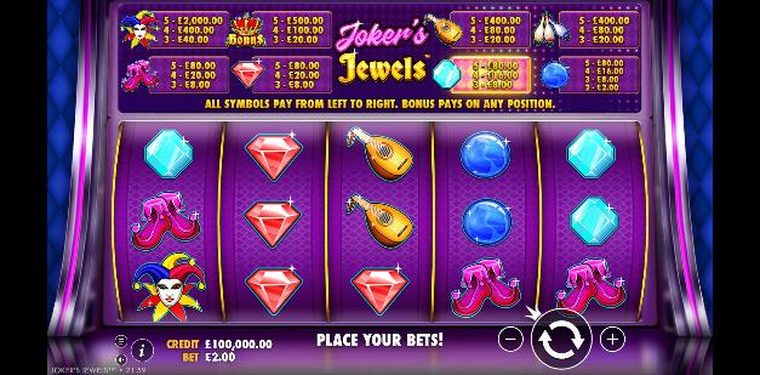
Joker's Jewels
Pragmatic Play · demo screen, 7 November 2026
Five reels, five lines, no wild, no scatter and no feature of any kind. The whole game is the paytable at the top of the screen, which makes it the easiest slot in a British lobby to understand completely.
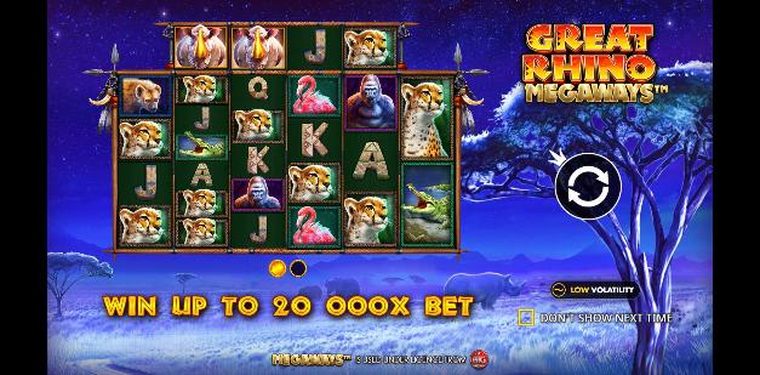
Great Rhino Megaways
Pragmatic Play · demo screen, 7 November 2026
The Megaways engine, licensed from the studio that invented it: each reel draws a random height on every spin, so the number of ways to win changes while you watch.
What the figure does not tell you
It does not tell you what a reader will lose, because what a reader will lose is drawn from a distribution and the figure is its centre. It does not tell you the cost per hour, which depends on spin speed and stake and is the number a player would actually find useful: a pound a spin at ninety-six per cent and six hundred spins an hour costs twenty-four pounds an hour in expectation, and the same return at twenty pence a spin costs under five.
And it says nothing about the shape of the loss. The same twenty-four pounds arrives as a slow grind on a low-volatility game and as four long droughts and one good feature on a high-volatility one, which is a different experience of an identical price.
The calculation worth doing once
Take the return figure, subtract it from one hundred, and that is the percentage of every stake the game keeps. Multiply by your stake and by the number of spins you expect in a session, and you have the expected cost of the entertainment.
A session of five hundred spins at fifty pence on a ninety-six per cent game costs ten pounds in expectation. That is the price of the evening, and the reason to do the arithmetic once is so that the deposit limit you set afterwards is a figure rather than a feeling!
Where volatility has gone
Steadily upwards, and the stake limits have accelerated it. A «maximum stake» of five pounds caps the top of the distribution, and a studio wanting to keep the possibility of a large win at a capped stake has to push the multipliers, which pushes the volatility. The visible consequence in a British «lobby» is a generation of games advertising maximum wins of five, ten and twenty thousand times the stake, which are real and are reached about as often as the arithmetic implies. A twenty-thousand-times maximum on a ninety-six per cent game does not change the price, and it changes how the price is distributed, and it moves almost all of it into outcomes almost nobody sees.
Questions readers ask
What is a good return-to-player figure?
A British slot typically sits between ninety-four and ninety-six and a half per cent, and the «live dealer» tables and video poker are higher. «Good» is relative to the category rather than absolute, and the figure matters much less than the stake and the duration, which you control and it does not.
Where do I find the figure for a specific game?
In the game's own information panel, which every licensed studio provides. That is the authoritative source because the same title can ship in more than one configuration, and the figure on any comparison site, including this one, is a copy that may describe a different version.
Does volatility change the return?
No, and this is the point most often missed. Volatility describes the width of the distribution and the return describes its centre, so a high-volatility and a low-volatility game can cost exactly the same over a long run while feeling nothing alike over a short one.
Why do new games advertise such enormous maximum wins?
Because the stake is capped at five pounds and a studio that wants to keep the possibility of a large prize has to increase the multiplier instead. The maximum is real, the return is unchanged, and almost all of the game's value has been moved into outcomes that very few players will ever see.
By the UK Pound Casino editorial team · Last updated November 2026 · Online since 2026